AI is being discussed in every boardroom, every industry event, and every vendor pitch deck across the GCC. The pressure to adopt is real and growing. But for many leaders of fast-scaling businesses, there's a quieter, more honest question underneath the noise: are we actually ready for this?
For most mid-sized businesses in the region, the honest answer is: not quite yet. But the gap is smaller and more clearly defined than most people assume. And closing it doesn't start with AI tools, it starts with the data foundations that determine whether AI produces reliable insight or expensive noise.
We're breaking down what AI readiness actually requires, where most growing businesses currently fall short, and a practical roadmap for getting there.
What AI Readiness Actually Means
The most common misconception about AI readiness is that it's primarily a function of budget or team size. In reality, it's a function of data maturity.
AI readiness means having the data foundations, infrastructure, governance, and organisational understanding in place for AI to produce reliable, useful outputs, rather than confident-sounding wrong ones.
The analogy is a highly capable new hire. Give them clean, well-organised information, a clear brief, and a good working environment, and they'll perform remarkably. Give them fragmented, inconsistent data and no context, and they'll produce impressive-looking work that leads you in the wrong direction.
Five components define genuine AI readiness:
- Data quality: clean, consistent, and complete data across your core business systems.
- Data accessibility: centralised, structured, and queryable from a single location.
- Governance: documented ownership, agreed definitions, and clear policies on access and quality.
- Organisational understanding: leadership clarity on what AI can and cannot do.
- Use case specificity: a clear articulation of which business problem you're actually trying to solve.
Where Most Regional Businesses Currently Stand
The data readiness gap is real, but it's not unique to the Middle East. Most mid-sized businesses globally are in a similar position.
What the GCC context adds is a specific pattern: the pace of business growth across the region has meant technology was often adopted reactively, tool by tool, as operational needs demanded. A CRM for the sales team. A marketing automation platform for the growth team. An ERP for finance. Each was chosen for immediate utility, without a long-term data strategy connecting them.
The result is a common picture: some form of data collection in place, basic reporting or dashboard capability, and a growing leadership awareness that data is strategically important, alongside a fragmented data landscape, no centralized warehouse, inconsistent metric definitions, and no clear governance to speak of.
This isn't a failure of ambition. It's a natural consequence of prioritising growth. But it does mean that deploying AI on top of this landscape, without first addressing the underlying fragmentation, will produce unreliable outputs that erode trust rather than build it.
The Four Dimensions of AI Readiness
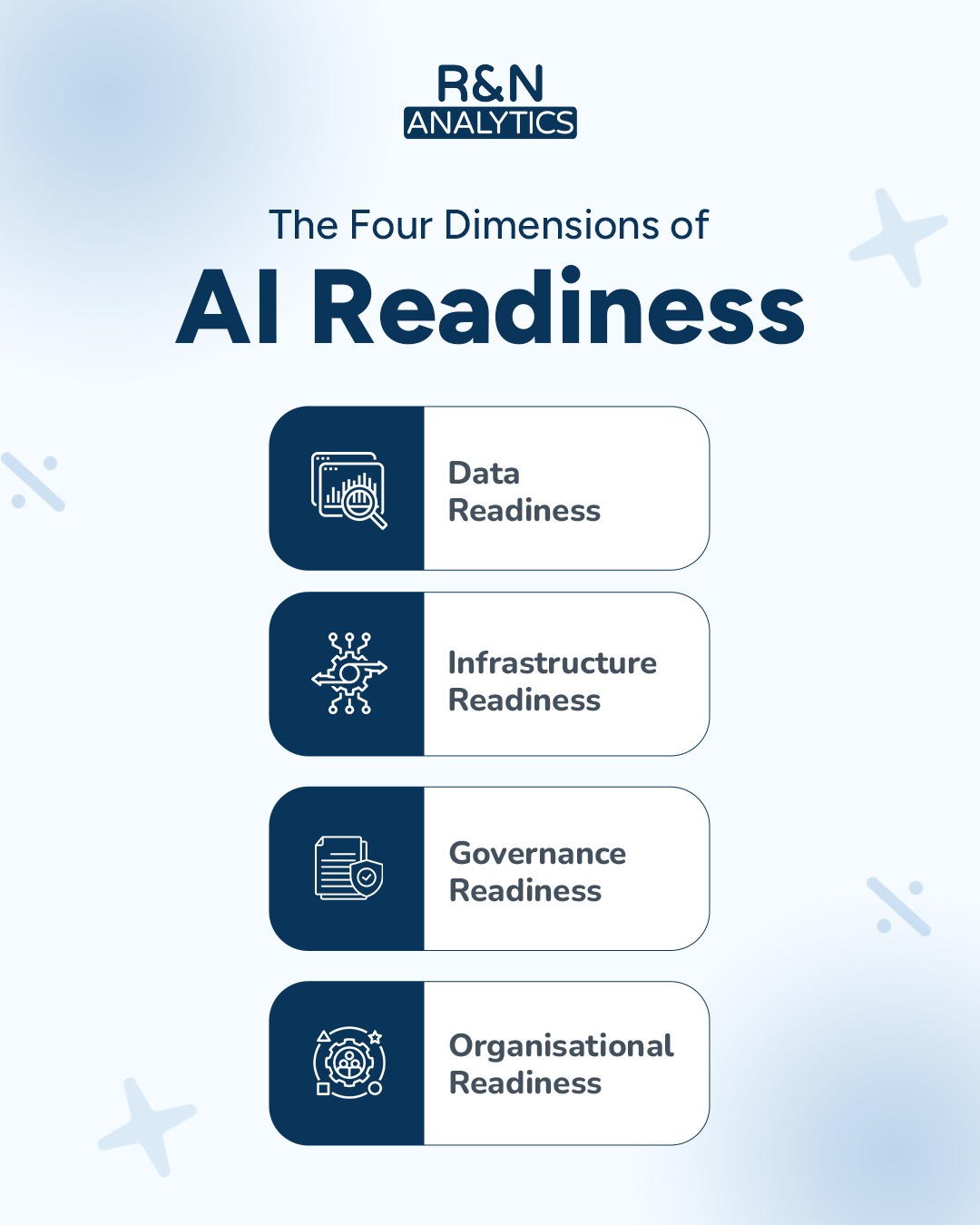
Data Readiness
Is your data clean, complete, and consistent? Does a single source of truth exist for your core business metrics, one that all teams agree on? Can you say with confidence that your data is reliable enough to make decisions on?
If the answer to any of these is no, this is the first and most important thing to address. Everything else depends on it.
Infrastructure Readiness
Is your data centralised in a warehouse that analytics tools and AI tools can connect to reliably? Are your data pipelines automated and monitored? Can you add a new data source without a weeks-long integration project?
Without this layer, AI has no stable environment to work in.
Governance Readiness
Do all teams agree on how key metrics are defined? Is there clear ownership for each data domain? Are there policies governing data access, quality, and privacy?
AI inherits and amplifies governance gaps. If your organisation has inconsistent definitions today, an AI system will produce inconsistently defined outputs at scale, faster and more confidently than any analyst would.
Organisational Readiness
Does leadership have a realistic understanding of what AI can and cannot do? Is there a specific, well-defined business problem that AI is being asked to solve, or is the ambition to "implement AI" in a general sense? Is there an internal capability or an external partner in place to manage and maintain AI systems responsibly?
Even technically excellent AI deployments fail without the organisational context to use them well.
The Risk of Deploying Without Readiness
The most dangerous AI outcome isn't a system that fails visibly. It's a system that produces confident-sounding wrong answers, which are harder to catch, more likely to go unchallenged, and more likely to influence decisions before anyone realises something is off.
The business consequences are specific. Marketing budgets are allocated based on flawed AI attribution models. Customer retention strategies target the wrong segments because the churn model was trained on incomplete data. Inventory decisions are driven by AI forecasts built on inconsistent historical records.
None of these failures is immediately obvious. They surface slowly, in declining performance, in confused leadership conversations, in growing distrust of data outputs that nobody can quite explain. By the time the root cause is identified, the cost is high.
This is why the sequence matters more than the speed: data readiness, then infrastructure, then governance, then the AI layer. Compressing or skipping steps doesn't accelerate the benefit, it accelerates the risk.
A Practical AI Readiness Roadmap
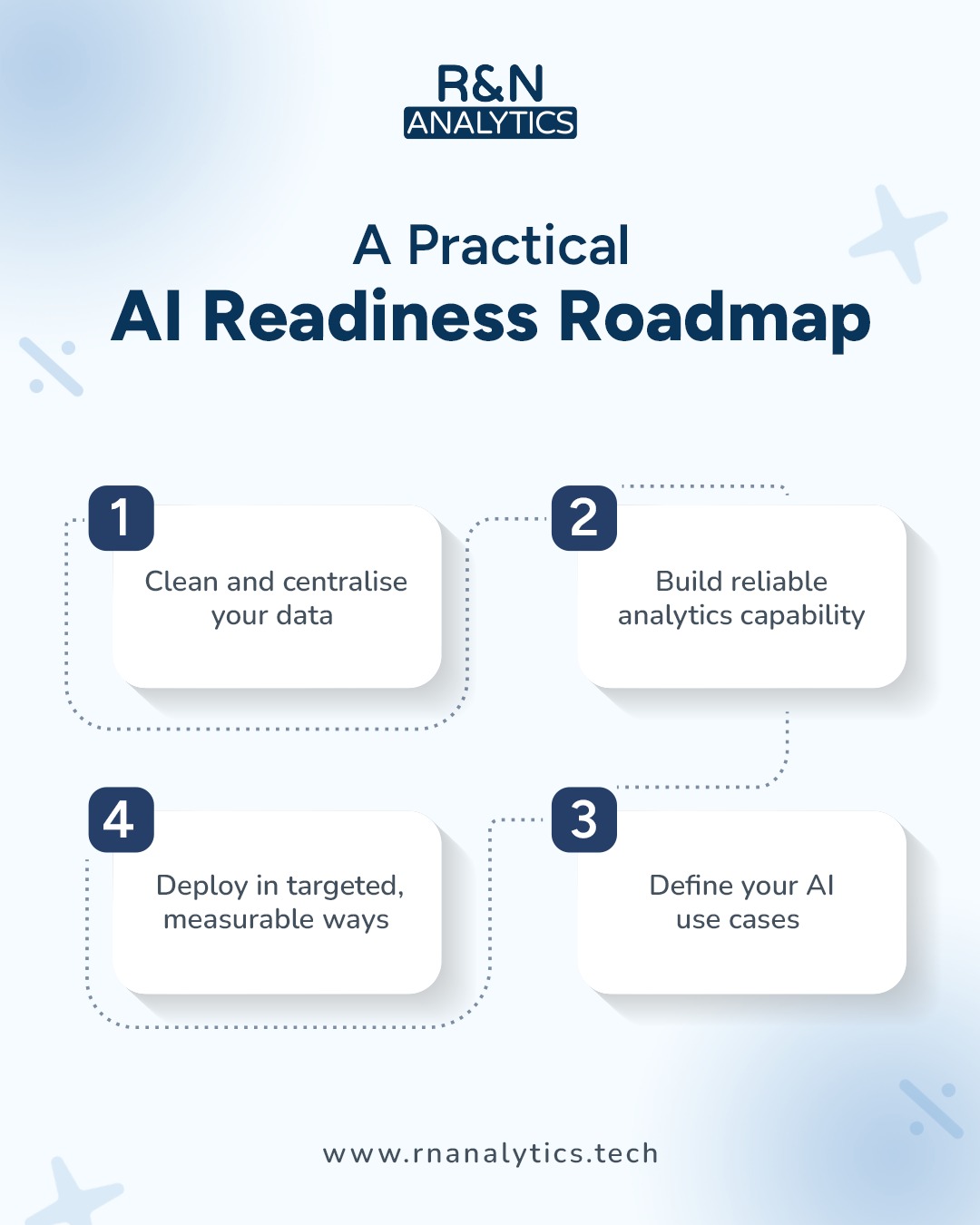
Stage 1: Clean and centralise your data
Audit your data sources and identify inconsistencies, gaps, and ownership ambiguities. Build or consolidate a central data warehouse. Establish agreed definitions for your most critical metrics, the ones that drive your most important decisions.
Stage 2: Build reliable analytics capability
Create a trusted reporting system that all teams work from. Build data models that connect your sources and reflect how the business actually operates. Establish data ownership and governance processes. This stage is less visible than building dashboards, but it's what determines whether everything built on top of it can be trusted.
Stage 3: Define your AI use cases
List the three to five decisions that most affect business outcomes. Assess whether AI can meaningfully improve the speed or quality of those specific decisions. Prioritise use cases based on data availability, business impact, and the feasibility of measuring whether AI actually improves the outcome.
Stage 4: Deploy in targeted, measurable ways
Start with one specific use case, not a platform-wide rollout. Measure outputs against a clear baseline. Build confidence and organisational capability before expanding scope. The discipline of starting narrow and measuring carefully is what separates successful AI deployments from expensive experiments.
The Competitive Case for Moving Now
The GCC is at a genuine inflection point. Digital infrastructure is maturing rapidly. Data volumes are increasing across every sector. AI tools are becoming accessible to businesses of all sizes, not just enterprise organisations with large technical teams.
The businesses that will benefit most from AI in the next three to five years are the ones building data foundations today. Every month of clean, well-structured data collected now becomes context and training material for AI systems in the future. Data maturity compounds; starting later means starting behind, and the gap widens over time.
AI readiness doesn't require a Silicon Valley budget or an enterprise data team. It requires clarity, discipline, and the right partner to build the foundations properly, and the judgment to build them before deploying the tools that depend on them.
The most important AI decision most businesses can make right now isn't which tool to adopt. It's whether their data is ready for any tool to work on. R&N Analytics helps fast-scaling businesses across the UAE and Saudi Arabia build that readiness, practically, sequentially, and without the hype.