Two companies. Same industry, same region, similar headcount and budget. One is consistently faster to act on market shifts, more precise in where it allocates resources, and more confident when presenting a strategy to investors. The other is always slightly reactive — decisions take longer, alignment is harder, and the margin for error feels narrower.
The difference, more often than not, comes down to one thing: how decisions are made.
Analytical decision-making is the discipline of using structured evidence, data, and clear thinking to guide business choices, rather than relying on intuition alone. It doesn't replace judgment. It sharpens it.
This is a playbook for leaders who want to build that discipline in themselves and across their organisation.
What Analytical Decision Making Actually Means
A common misconception: analytical decision making means handing decisions over to data scientists or letting algorithms drive the business. It doesn't.
It means leaders actively using data to pressure-test their assumptions, challenge their instincts, and bring more precision to the choices that matter most.
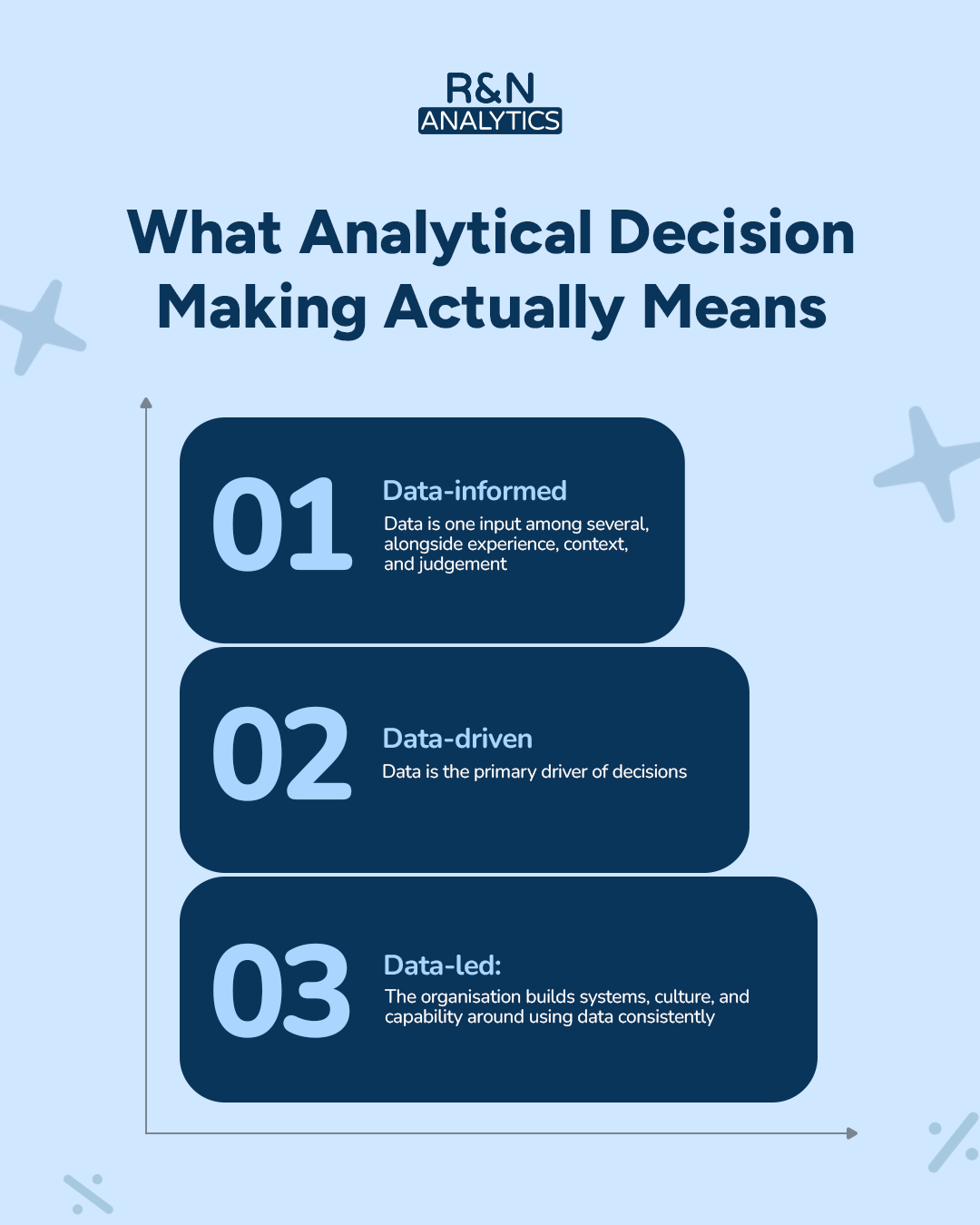
Three terms are often used interchangeably but mean different things:
- Data-aware: Using historical reports to describe what has happened. The most common starting point for most businesses.
- Data-informed: Using data as a key input into a judgment-based decision. Leaders weigh evidence alongside experience and context.
- Data-led: Decisions are structured primarily around data outputs, with clear frameworks for how evidence is weighted and acted upon.
For most growing businesses, the realistic and valuable ambition is to become data-informed first, and build toward data-led over time. Skipping straight to 'data-driven' often produces brittle decisions that ignore context that numbers can't capture.
Why This Matters Now, Especially in the Middle East
Across the UAE, Saudi Arabia, and the broader GCC, digital transformation has accelerated sharply. E-commerce, healthcare, financial services, and logistics are generating more transactional data than at any point in the region's history.
The challenge is no longer access to data. It's the capability to use it. Most senior decision-makers running high-growth regional businesses did not come from technical backgrounds, which creates a meaningful gap between the data available and the decisions being made.
The Anatomy of an Analytical Decision
What does a well-structured analytical decision actually look like in practice? It doesn't need to be complicated. For most recurring decisions, it becomes a habit rather than a process.
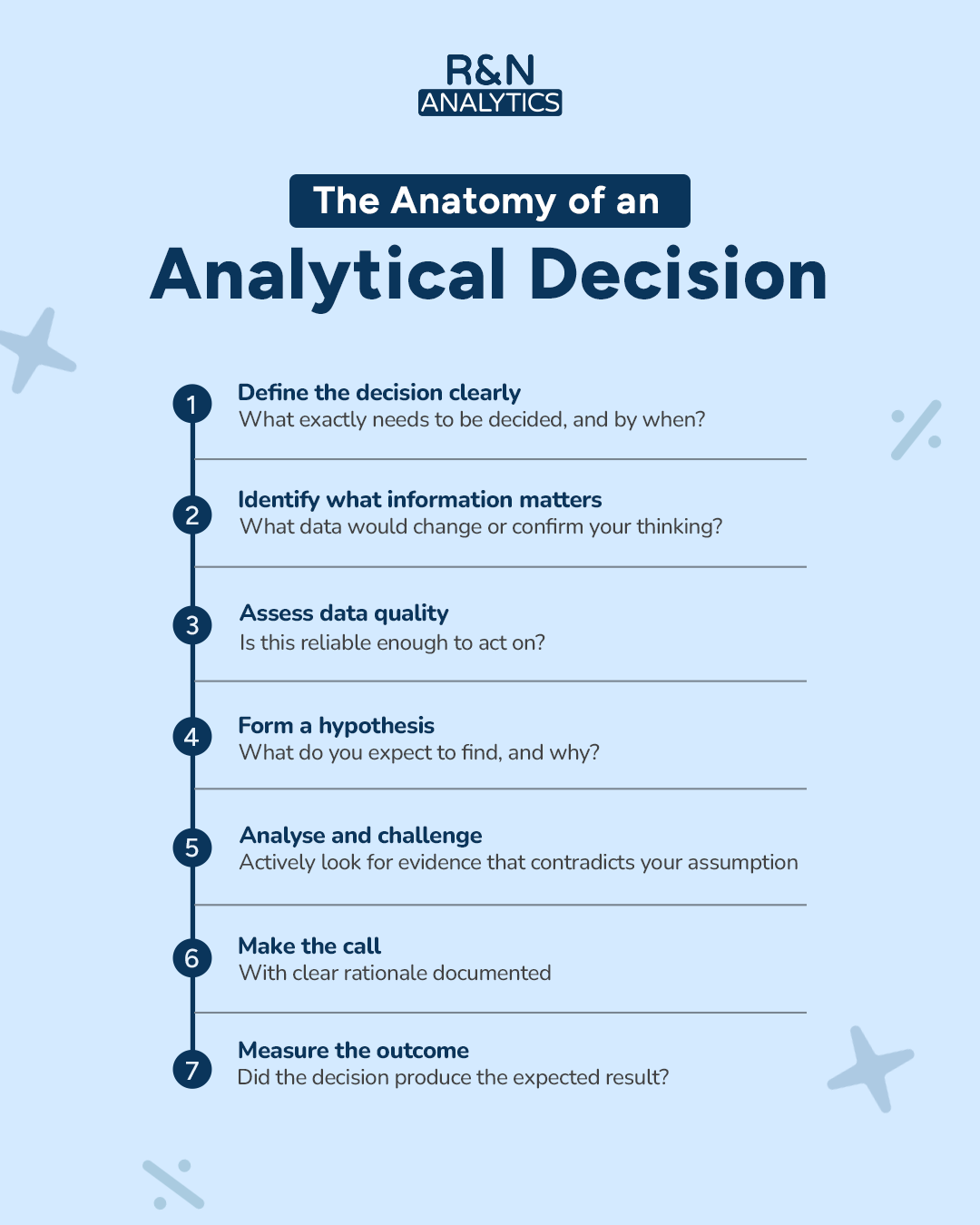
The last step is the one most organisations skip. Closing the feedback loop — comparing outcomes to the assumptions that drove them — is how analytical capability improves over time. Without it, the same mistakes repeat and the same blind spots persist.
The Barriers Leaders Face, and How to Overcome Them
In practice, there are four barriers that stop leaders from making analytical decisions, even when they want to.
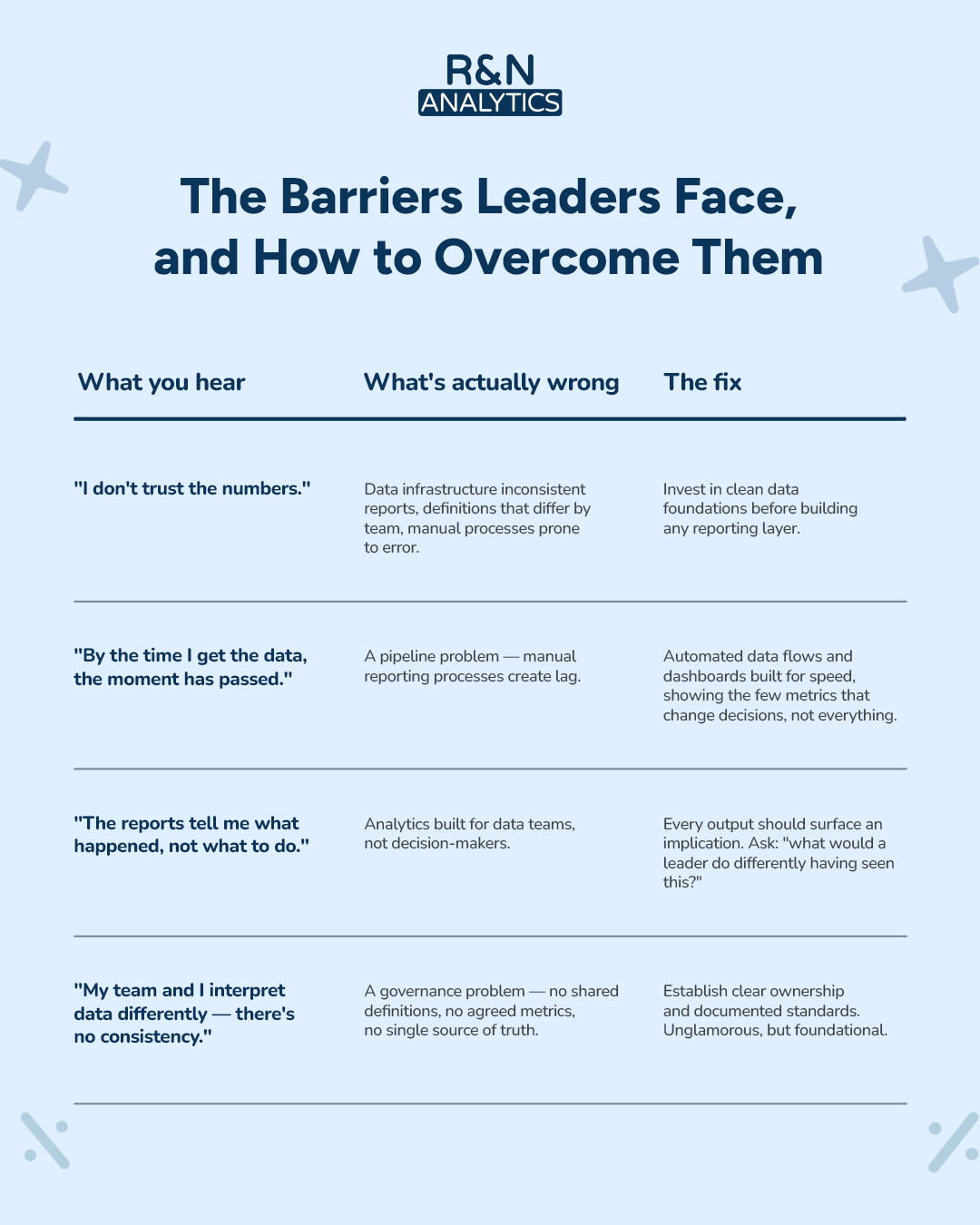
- Data they don't trust: If leadership suspects the numbers are wrong, they default to gut instinct. Fixing foundational data quality is the prerequisite for everything else.
- Data they can't access: When answers require three teams, two tools, and a week of waiting, most decisions proceed without them. Self-serve reporting removes this friction.
- Data they can't interpret: Raw metrics without business context don't support decisions. Analytical outputs need to speak the language of the person making the call.
- No time or process: Without a structured decision cadence, analytical thinking gets crowded out by urgency. Building it into meetings and review cycles makes it the default rather than the exception.
Building an Analytically Confident Organisation
Analytical decision making is ultimately a cultural challenge as much as a technical one. The businesses that do this well share a few common traits:
- Leaders ask 'what does the data say?' as a default, not an afterthought
- Decisions are documented with clear rationale, and revisited after outcomes are known
- Metrics are owned and maintained, not just tracked
- Data literacy is treated as a business skill, not a technical specialism
- Analytical outputs are designed for the boardroom, not the data room
Building this culture starts with leadership behaviour. When a CEO regularly asks 'what does the data show?' in senior meetings, it changes how the rest of the organisation prepares and presents. The signal from the top matters more than any tool or dashboard.
This is the model we work toward with every client at R&N Analytics. We don't just deliver dashboards — we design reporting that leadership actually uses, translate data findings into business language, and build infrastructure that makes it possible for non-technical leaders to get answers independently. The goal is always to build capability that outlasts the engagement, not dependency that requires us to stay.
The Role of an Analytics Partner in This Journey
For most growing businesses, building full analytical capability in-house from scratch is impractical and expensive. A senior analytics team capable of doing this work well costs significantly more than most mid-sized businesses can justify before the capability has proven its value.
An external analytics partner plays a different role from a vendor. Rather than simply delivering dashboards, the right partner helps embed analytical thinking across the organisation — designing reporting that executives actually use, translating data into business language, and building infrastructure that makes self-serve analysis possible for non-technical leaders.
A Practical Starting Point
You don't need to transform your entire analytics function overnight. Here's where to start:
- Audit how major decisions are currently being made: how much data, if any, is actually used?
- Identify your three most important recurring decisions: the ones made monthly or quarterly that most directly affect growth.
- Map the gap: what information would make those decisions clearer or faster?
- Fix the foundation: ensure data is clean, connected, and trustworthy before building any reporting.
- Design for the decision-maker: build outputs that answer specific questions, not generic performance summaries.
- Build a review cadence: regularly revisit both the decisions you're tracking and the assumptions behind them.
Analytical decision making is about becoming a more confident, more precise leader — one who uses evidence to sharpen judgment rather than replace it.
The businesses that will define the next decade in this region aren't necessarily the ones with the most data. They're the ones who know how to use it.